Source: Blog-Agent-Worker project files, MEMORY.md project notes, Railway deployment
Pipeline diagram (2026-05-09)
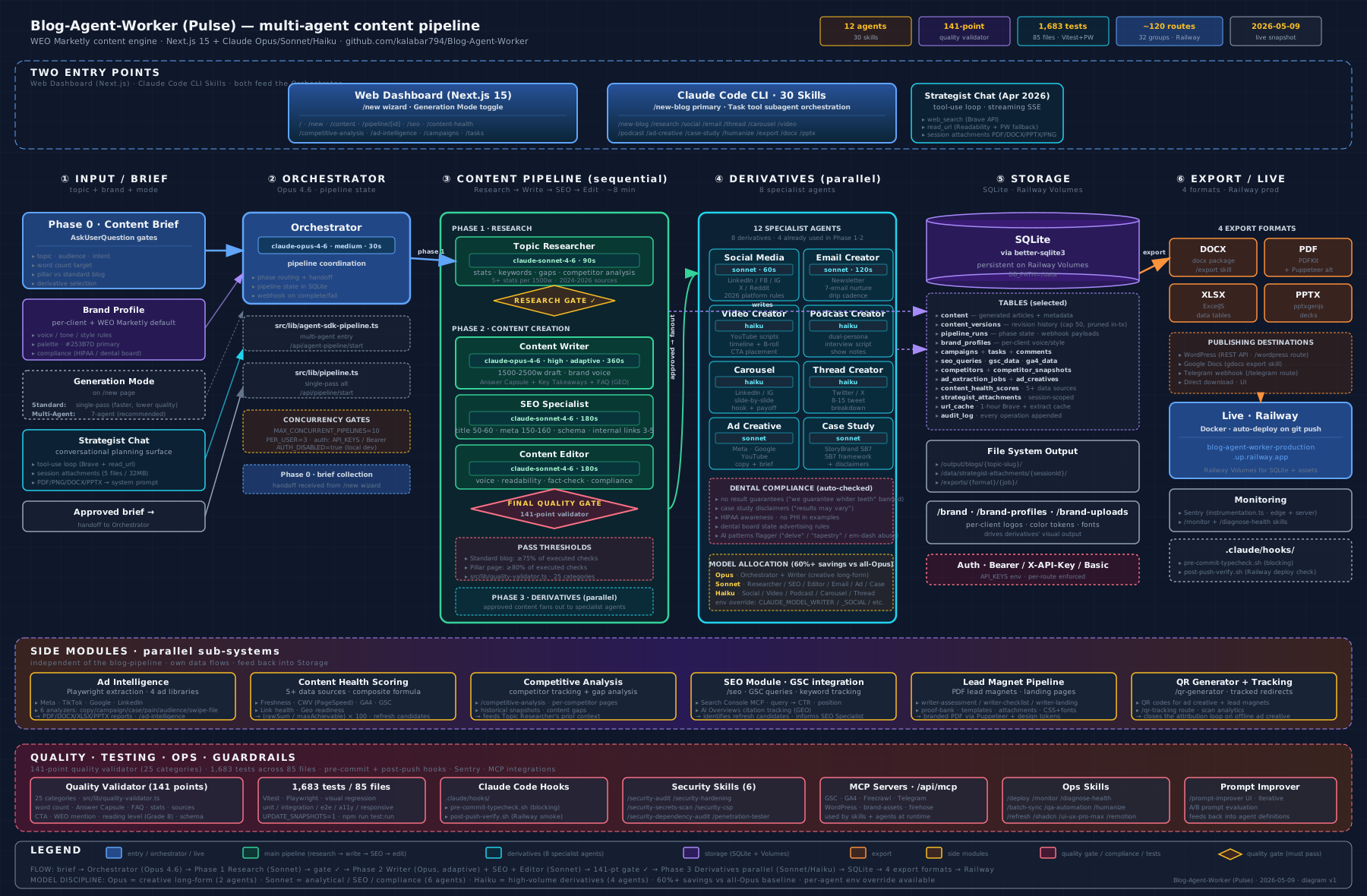
Single-image overview of the entire system — two entry points (Web Dashboard + Claude Code CLI), 6-column flow (Input → Orchestrator → Content Pipeline → Derivatives → Storage → Export/Live), side modules band (Ad Intelligence, Content Health, Competitive Analysis, SEO+GSC, Lead Magnet, QR), quality+testing+ops band underneath. The two checkpoints — Research Gate (amber) and Final Quality Gate (rose, 141-point validator) — are visible in the third column. Source SVG: baw-pipeline-2026-05-09.svg. Companion image lives in the BAW repo at docs/diagrams/baw-pipeline-2026-05-09.svg + @2x.png.
A cloud-deployable web application for automated marketing content generation using a multi-agent pipeline. Pulse handles blogs, social posts, email sequences, ad intelligence, and competitive analysis through 12 specialized agent definitions. The flagship feature is the 7-agent sequential pipeline (Research, Write, SEO, Edit, Social/Email parallel) which consistently outperforms single-pass generation in quality tests. Deployed on Railway at blog-agent-worker-production.up.railway.app.
What It Does
- Generates long-form blog content (1500-2500 words) with SEO optimization
- Runs 7-agent sequential pipeline for highest quality output
- Validates content against 117-point quality checklist
- Produces derivative content: social posts, email sequences, ad creative
- Extracts ad intelligence from Meta, TikTok, Google, LinkedIn ad libraries
- Scores content health across 5+ data sources
Stack
- Runtime: Node.js 20
- Framework: Next.js 15 with Tailwind CSS
- Database: SQLite (content storage, generation history)
- AI: Claude Opus 4.6 (orchestrator, writer), Sonnet (SEO, editor, researcher), Haiku (social, email)
- Deployment: Railway (blog-agent-worker-production.up.railway.app)
Two Generation Pipelines
Standard Pipeline (Single-Pass)
- Single Claude call generates complete content
- Faster but lower quality
- Suitable for high-volume derivative content
Multi-Agent Pipeline (7 Specialized Agents)
Sequential execution with handoffs:
- Research Agent (Sonnet, 90s timeout) — Topic research, source gathering, competitive analysis
- Writer Agent (Opus, 360s timeout) — Long-form content generation from research brief
- SEO Agent (Sonnet, 180s timeout) — Title optimization, meta descriptions, keyword integration, schema
- Editor Agent (Sonnet, 180s timeout) — Voice consistency, readability, fact-checking, grammar
- Social Agent (Haiku, 60s timeout) — Platform-specific social post derivatives (parallel with Email)
- Email Agent (Haiku, 60s timeout) — Email sequence derivatives from blog content (parallel with Social)
The Orchestrator (Opus, 30s timeout) coordinates handoffs and manages pipeline state.
12 Agent Definitions
| Agent | Purpose |
|---|---|
| topic-researcher | Discover topics, gaps, trending angles |
| content-writer | Generate long-form blog content |
| seo-specialist | Optimize for search engines and AI Overviews |
| content-editor | Polish voice, readability, accuracy |
| social-media-creator | Platform-specific social posts |
| email-creator | Email sequence generation |
| video-creator | Video script outlines from content |
| podcast-creator | Podcast episode scripts |
| carousel-creator | Instagram/LinkedIn carousel content |
| thread-creator | Twitter/X thread breakdowns |
| ad-creative-creator | Ad copy and creative briefs |
| case-study-creator | Case study generation with compliance |
Agent Model Allocation
Strategic model selection based on task complexity:
- Opus — Orchestrator (coordination), Writer (creative long-form). High cost, highest quality
- Sonnet — Researcher (analysis), SEO (technical optimization), Editor (review). Balanced cost/quality
- Haiku — Social (derivatives), Email (derivatives). Low cost, high volume
Content Quality Standards
- Word count: 1500-2500 words (standard), higher for pillar pages
- Sources: 3+ cited sources per article
- SEO title: 50-60 characters
- Meta description: 150-160 characters
- Answer Capsule: 2-3 sentences after H1 (optimized for AI Overviews citation — the GSC engine can identify which queries need this)
- FAQ section: 5-7 Q&As with schema markup
- Reading level: 8th grade (Flesch-Kincaid)
- Fact density: ~5 statistics per 1500 words with citations, 2024-2026 sources
117-Point Quality Validation
Automated quality gate before human review:
- Standard content: Must pass 75% of checks (88/117)
- Pillar pages: Must pass 80% of checks (94/117)
- Categories: Structure, SEO elements, readability, compliance, sources, formatting, schema, accessibility
Dental Compliance Rules
- No result guarantees (“We guarantee whiter teeth” is banned)
- Case study disclaimers required (“Results may vary”)
- HIPAA awareness (no patient-identifiable information in examples)
- Dental board advertising rules (state-specific restrictions)
Ad Intelligence Module
Playwright-based extraction from ad libraries:
- Platforms: Meta Ad Library, TikTok Creative Center, Google Ads Transparency Center, LinkedIn Ad Library
- 6 Analyzers:
- Copy analyzer — Messaging patterns, tone, word choice
- Campaign analyzer — Budget allocation, targeting, scheduling
- Case-study analyzer — Before/after patterns, proof points
- Pain-categorizer — Customer pain points by category
- Audience analyzer — Demographic and psychographic targeting
- Swipe-file builder — Best-performing creative for reference
Content Health Scoring
Multi-source health assessment formula: (rawSum / maxAchievable) * 100
| Data Source | What It Measures |
|---|---|
| Freshness | Date decay — older content scores lower |
| CWV (PageSpeed) | Core Web Vitals performance |
| GA4 | Engagement metrics (time on page, scroll depth) |
| GSC | Click-through rate and position data |
| Link health | Internal/external link status |
| Geo readiness | Local SEO and AI Overviews optimization |
No single source is sufficient. The composite score reveals content that looks good on one metric but fails on others.
Key Takeaways
- Multi-agent sequential beats single-pass generation every time — the research phase alone dramatically improves factual accuracy
- Answer Capsule + FAQ are now required for GEO (Generative Engine Optimization / AI Overviews citation)
- Model allocation matters: Opus for creative, Sonnet for analytical, Haiku for high-volume derivatives saves 60%+ on API costs vs using Opus for everything — see SEO Patterns Learned for cross-project model selection guidance
- 117-point quality validation catches issues before human review, reducing revision cycles
- Content health scoring from 5+ data sources reveals problems that single-metric tools miss
- Ad intelligence provides competitive creative analysis that informs content strategy
Related
- gsc-autonomous-seo — GSC engine identifies pages that need content improvement
- seo-audit-skill — Validate generated content before publishing
- clawdbot-competitive-intel — Competitive data feeds content gap analysis
- ecosystem-architecture — How Pulse connects to the optimization loop
- seo-patterns-learned — Multi-agent patterns extracted from building Pulse
- marketing-automation-use-cases — Content automation workflows
- AI Video & Content Production — video content production, the parallel pipeline (the detailed workflow article is internal)
- _index — Hermes Agent scheduling for automated runs
Try It
- Visit blog-agent-worker-production.up.railway.app for the web interface
- Try the multi-agent pipeline on a topic: select “Multi-Agent” mode, enter a dental marketing topic
- Review the 117-point quality report that accompanies each generation
- Use the ad intelligence module to analyze competitor creative before writing competitive content
- Check content health scores for existing blog posts to identify refresh candidates