Full annotated catalog: Hermes Agent — Full Catalog — every entry below with its complete description. This index carries the one-line version for navigation.
Hermes Agent is Nous Research’s self-hosted, self-improving agent framework — a stateful agent that learns from experience, remembers across sessions, and runs 24/7. This topic tracks its architecture, memory model, security, skills, and the growing community ecosystem of dashboards, plugins, themes, and integrations around it.
WEO Marketly’s applied Hermes articles (deployment, configuration as run internally, marketing and ops integrations) live in the internal work vault at weomarketly:hermes-agent/_index; that copy’s framework-core articles are frozen at the 2026-05-06 migration, so this topic is the current reference for releases and framework changes.
Currency check — 2026-08-05
Current release: v0.20.0 “The Herald Release” (
v2026.8.3), verified against the GitHub releases page on 2026-08-05. (Corrected 2026-08-05: this callout previously named v0.19.0 “Quicksilver” (v2026.7.20) as current — that was accurate at its 2026-07-24 check but had since fallen two releases behind, asv2026.7.30(v0.19.1, an infrastructure patch tag now rolled into v0.20.0) andv2026.8.3both shipped. The lag is exactly the structural risk the rest of this callout describes.) Nous ships between releases through skills and model availability rather than version bumps, so the release article alone will lag: the newest feature at this check is the tldraw-offline skill (2026-07-23), which shipped as a skill install three days after the release. Update withhermes update; checkhermes skillsfor what landed since.
Visual overview
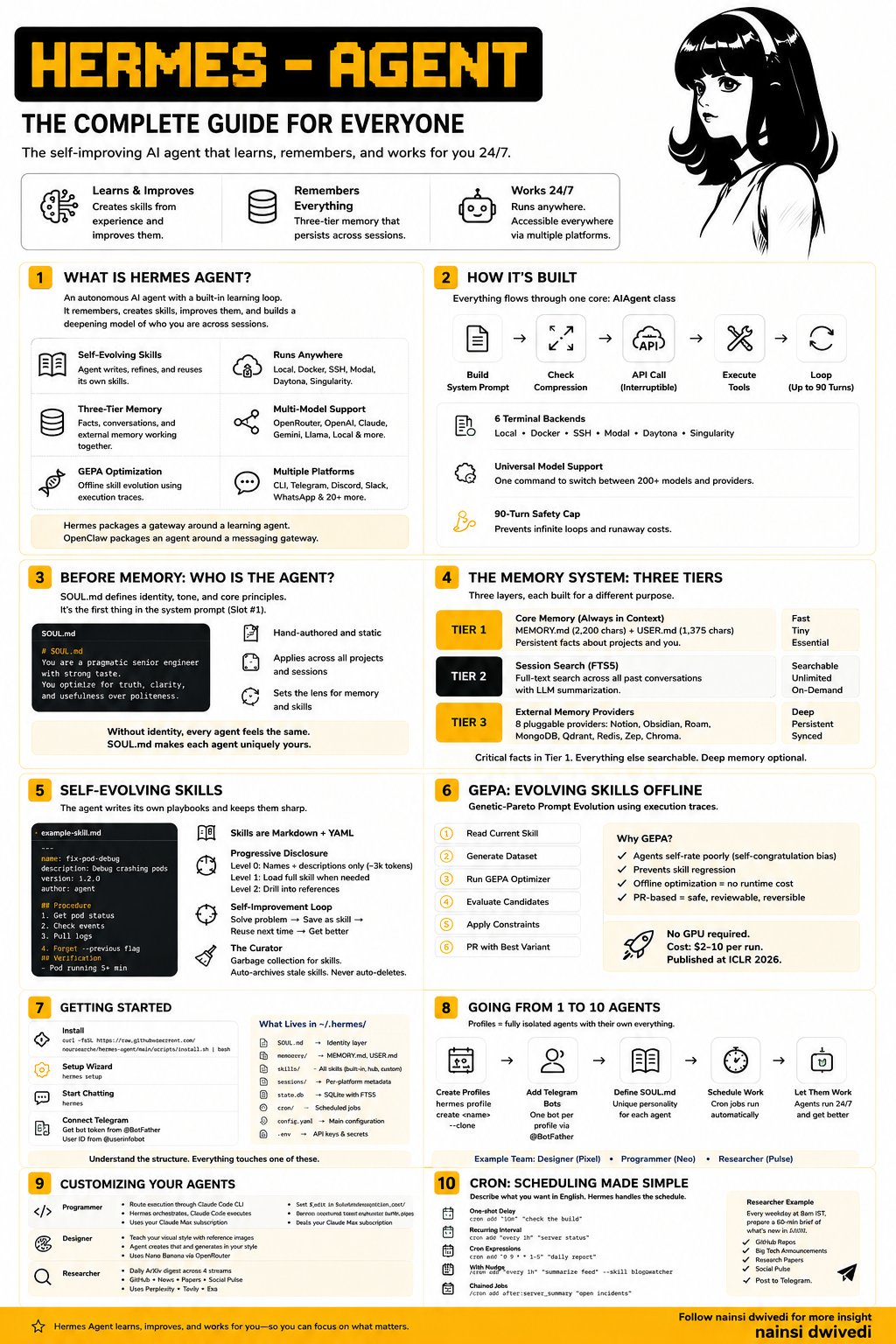
One-page community infographic by nainsi dwivedi. Ten-section visual walkthrough: (1) what Hermes Agent is — learns, remembers, works 24/7; (2) how it’s built — AIAgent class loop (build system prompt, check context compression, API call, execute tools, loop up to 12 turns); (3) before-memory identity via SOUL.md as the load-bearing system prompt; (4) three-tier memory system — Tier 1 Core Memory in Context (2,200 chars plus a 1,375-char USER.md, persistent across projects, fast and essential), Tier 2 Session Search (full-text search across all past conversations with LLM summarization, searchable and on-demand), Tier 3 External Memory Providers (pluggable — Obsidian, Notion, Roam, MongoDB, Upbrand, Redis, Zep, Chroma; deep, persistent, synced); (5) self-evolving skills written as Markdown plus YAML with progressive disclosure (Level 0 names, Level 1 metadata, Level 2 drill into reference files); (6) GEPA — Genetic-Pareto Prompt Evolution evolving skills offline using execution traces (no GPU required, roughly 2 to 10 USD per run, published at ICLR 2026); (7) getting started — curl install, setup wizard, start chatting, Telegram connect; (8) going from 1 to 10 agents (full profiles in ~/.hermes/ versus fully isolated); (9) customizing your agents (Programmer / Designer / Researcher / Coder example team); (10) CRON scheduling made simple with YAML config. A useful “show me Hermes in one page” surface for anyone arriving cold to the topic — sister visual to Nate Herk’s 1-hour course narration. Caveat: community-made distillation, not Nous Research’s official documentation — verify load-bearing figures (the 12-turn loop cap, the GEPA per-run cost, the Tier-1 character counts) against hermes-agent.nousresearch.com/docs before quoting in production work.
Framework, skills, clients, integrations and community builds
Note: this section is the topic’s general article pool — courses and walkthroughs sit alongside client apps, plugins, skills, and integration write-ups. It has outgrown a single flat list; splitting it into sub-sections (courses / client surfaces / skills / integrations / field reports) is a pending organizational cleanup, not a content gap.
-
Access Your Hermes Agent From Anywhere — Tailscale + Termius + tmux — YouTube walkthrough of a three-tool remote-access stack for reaching a self-hosted Hermes host from any device with zero public-port exposure: Tailscale (private WireGuard mesh — devices reachable by MagicDNS name, peer-to-peer, free personal plan) solves reach; Termius (mobile-grade SSH client with command keyboard, mosh, port forwarding) solves control; tmux (tmux owns the shell, SSH is just a window into it) solves persistence so agentic loops survive dropped SSH / closed laptop / bad Wi-Fi.
-
Hermes Skill Bundles — Slash-Command Skill Composition — New Hermes feature shipped with v0.14.x. Save a named set of skills behind one slash command (e.g.,
/research,/release-prep,/incident-response). -
* Turns to Codex CLI — Opt-in runtime that delegates
openai/*andopenai-codex/*turns to OpenAI’s Codex CLI instead of running Hermes’ own tool loop. -
Hermes Agent — Security Model (Defense-in-Depth) — Nous Research’s official seven-layer security model for self-hosted Hermes deployments: (1) dangerous command approval against a curated pattern list (
rm -rf,bash -c,curl \| sh,teeto~/.ssh, etc.), (2) container/sandbox isolation, (3) MCP-server credential scoping (each MCP subprocess sees only its declaredenvblock, not the full host env), (4) credential redaction in error messages (ghp_...,sk-...,token=, etc. →[REDACTED]), (5) website access policy, (6) user authorization on messaging channels, (7) encrypted secrets at rest (decrypted only at heartbeat). -
Hermes Agent — User Stories and Use Cases — Community-curated catalog from Hermes’ official docs across five categories: Privacy & Self-Hosted (Tailscale serve for secure remote access without exposed ports), Business Ops (Google Slides, Hunter.io for sales outreach, live inventory tracking, AgentMail email-inbox via MCP), Integrations (JMAP for Fastmail), Personal Assistant (Google Tasks), Meta & Ecosystem (OpenClaw → Hermes shadow-mode migration, real cutover testimonials).
-
Hermes Skins — Community Visual Themes for the Hermes CLI Agent (joeynyc) — Community-curated visual-theme bundle for the Hermes CLI agent (380★, MIT, Python). 15 custom skins (Pirate, Vault-Tec, Bubblegum 80s, Skynet, Lain, Neonwave, Sakura, Netrunner, Mythos, Nous, Mother, DOS, Telemate, Empire, Catppuccin) + reference docs for the 7 built-in skins shipped with Hermes (default, ares, mono, slate, poseidon, sisyphus, charizard).
-
Hermes MemoryKit — duclamvan’s 8-Layer Memory Stack for Hermes (v0.2.0) — Memory toolkit extending Hermes’s three-tier memory model with an opinionated 8-layer stack: LCM raw transcript → native memory → QMD/markdown wiki → entity graph → hybrid RRF router → focus brief → regression tests → nightly maintenance.
-
Hermes Console — Obsidian Plugin for Hermes Agent (Danny Shmueli, v1.1.14) — Obsidian community plugin embedding Hermes as a tabbed PTY terminal inside the vault.
-
Bun, 189★, v1.7.1) — Tabbed, mouse-aware TUI built with OpenTUI (React renderer) + Bun.
-
SwiftUI, 1.6k★) — Native macOS companion that manages a Hermes host over pure SSH — “no gateways, no exposed ports, no browser layer.” Eight focused views (Overview / Sessions / Workflows / Kanban / Files / Cron / Usage / Skills / embedded Terminal) over the host’s own state, with the host as the only source of truth (no daemon, no local mirror, no sync layer).
-
Linux) — Nous Research’s first-party desktop app for Hermes Agent (MIT, v0.15.2): one cross-platform install (macOS 12+ / Windows 10-11 / Linux) packaging the full stack behind a GUI.
-
Hermex — Native SwiftUI iPhone Client for Hermes Agent (uzairansaruzi, Swift, 39★) — Open-sourced 2026-07-02 (MIT). Native SwiftUI iOS app (not a web wrapper; iOS 18+; Xcode 26+ to build) that is “a mobile cockpit for an AI agent that lives on a machine you control” — points at a self-hosted hermes-webui server the user already runs.
-
Companion for Hermes Agent (db-aeon, AGPL) — open-source AGPL cloud desktop where the agent is available 24/7 via voice, text, or shared desktop; open-sources the commercial Joshu LGUI showcase.
-
Hermes Agent Cloud — Deploy Hermes Agents in the Cloud via Nous Portal — Launched 2026-07-08. Select a model + server size and the agent instance goes live in ~60 seconds with two clicks, provisioned at
portal.nousresearch.com/cloud. -
Nous Portal — Unified Subscription Backend for Hermes Agent — Nous Research’s unified subscription + model-access backend for Hermes Agent: one plan gives metered access to 300+ models plus hosted tools (web search / scraping / image gen / browser use / code execution / voice) from a single credit pool — no per-provider API keys.
-
Hermes Multi-Agent Workflow — Kanban-Coordinated Triage Pipeline Template (tonbistudio) — Reusable MIT template for an autonomous, human-gated multi-agent triage pipeline on Hermes:
sources → intake → dedup → score → research (parallel) → route → HUMAN GATE → fulfill → deliver, all coordinated on one Hermes Kanban board as the message bus / dispatcher / fan-in. -
RUDR9 — Turning Hermes Agent Into a Dev Team via Toolset Restriction, Not Prompts — One-command installer (MIT, 29 stars) turning a Hermes install into an 8-role dev organization (CTO + Planner/Architect/VCM/Builder/Security Auditor/Performance Auditor/Reviewer) coordinated via Hermes’ Kanban board.
-
Hermes GAPA — Self-Improvement Loop (v0.8.0) — GAPA (Get-Act-Plan-Act) is Hermes’s runtime self-evolution mechanism: every ~15 tool calls it reviews its trajectory, writes a new skill if a reusable pattern emerged, and updates MEMORY.md — “back-propagation for prompts.” 5 stages (trajectory capture → LLM review → skill creation → memory update → compounding reuse).
-
Hermes Memory Providers — 9 Pluggable External Memory Providers Compared — Pluggable memory backend interface (since v0.7.0): 9 external providers (Honcho, OpenViking, Mem0, Hindsight, Holographic, RetainDB, ByteRover, Supermemory, Memori) compared across cost, hosting, trust model, and setup difficulty.
-
Hermes Profiles & Multi-Instance — Running Multiple Isolated Agents — A profile is a fully isolated
HERMES_HOMEat~/.hermes/profiles/<name>/— its own config, keys, memory, sessions, skills, cron, and subprocess$HOME. -
Hermes Autonomous SWE Workflow — Model Routing via Kanban (Shubham Saboo) — Worked-example infographic + thread showing Hermes as an orchestrator that routes a coding task by complexity: simple scoped work (patches, tests, repo cleanup) → SmallCode + Ollama on a Mac mini (terminal-native agent running local models like Gemma 4 at zero API cost); hard/ambiguous work (reasoning, architecture, reviews) → Claude or Codex.
-
Hermes Plugin — MemeLord (karmsheel, dashboard plugin example) — Meme generation + gallery plugin for the Hermes Agent dashboard (
hermes dashboard --tui --port 9119). 11 built-in templates (Drake / Distracted Boyfriend / Two Buttons / Expanding Brain / Anakin & Padme / Change My Mind / This Is Fine / Always Has Been / Bernie Sanders / Epic Handshake / Running Away Balloon) + Imgflip catalog discovery with 1h cache + drag-and-drop upload + JSON-backed humor profile (safe mode, blocked topics) + exclusive KingPepe theme (PEPE aesthetic, scanline overlay, Orbitron + Share Tech Mono). -
RoboNuggets) — Beginner-tier intro built around Jay’s recurring three-element model + harness + context framework (same framing he uses in OpenClaw Concepts).
-
Hermes Agent — Zero to Personal AI Assistant (Nate Herk 1-Hour Course) — May 2026 YouTube walkthrough by Nate Herk. Covers the five-pillar mental model (memory / skills / soul / crons / self-improving loop), Hostinger one-click VPS setup with the Docker route (KVM 2 plan, code
Nate Herkfor 10% off annual), OpenAI Codex authentication via ChatGPT subscription OAuth (cheapest non-open-source path), Telegram channel wiring through BotFather, the Cloud-Code-as-VPS-manager pattern (one Claude Code project tracks all VPS agents’ passwords/env/IPs/integration notes), live cron-creation demo where Hermes self-detects a daylight-savings gotcha and installs an hourly self-checked variant, multi-agent decision tree (when to spin up a new Hermes vs keep one mega-agent), and operator hygiene (least-privilege API keys, separate Gmail per agent, stale memory is the #1 cause of weird agent behavior). -
Hermes MCP Catalog — One-Click Install for Nous-Approved MCP Servers — Built-in catalog of PR-reviewed MCP servers installable in one command (
hermes mcp/mcp install <name>/mcp configure <name>), instead of hand-pasting JSON intoconfig.yaml. -
Set Up a Grok Subscription in Hermes Agent (xAI OAuth, No API Key) — Concrete setup walkthrough (YouTube, AI Garage) for using a SuperGrok subscription as a Hermes model provider via OAuth — no xAI API key.
-
Hermes Agent Masterclass (4-Part Hands-On Series) — Build-it-live YouTube walkthrough (AI Garage, first 4 of an 11-part series) taking a fresh WSL2 machine to a 24/7 agent.
-
Stripe Payments Skill Suite — first-party Hermes + Stripe skills (stripe-link-cli, mpp-agent, stripe-projects) for agent commerce (buy on the open web, pay-per-call APIs, provision SaaS), installed via
hermes skills install official/payments/<skill>, with human-approval gates + credential isolation. -
Hermes Accelerated Business Hackathon — Custodian, Mom-n-Pop Skills, CashFromChaos — Nous Research + NVIDIA + Stripe hackathon (292 submissions) challenging builders to run real Hermes-based commerce. 1st place Custodian: a safety kernel gating real Stripe payments with cryptographic approval receipts, a human kill switch, and self-policy-rewrite detection — a hackathon-proven, standalone parallel to Hermes’ own incoming Write Gate. 2nd — Mom-n-Pop Skills, a Telegram-only, owner-approval-gated CRM/pricing/marketing agent for non-technical small-business owners. 3rd — CashFromChaos, an end-to-end recommerce agent (photo → listing → negotiation → Stripe escrow → payout) built on Hermes + Nemotron.
-
Hermes Personal-Agent Briefing (Dmitry Shapiro, MindStudio) — practitioner what-it-is/why/how briefing: harness mental model, activity-dependent model selection, GBrain long-term-memory layer, customization dimensions, 2 metric-backed case studies.
-
Dmitry Shapiro’s Multi-Agent Hermes Architecture — Watson, Sherlock & Harry — Live-webinar walkthrough (2026-07-02) of Shapiro’s actual production setup: three named agents across two physical machines (Watson as chief-of-staff triaging Linear webhooks, Sherlock as delegate-worker, Harry running free local inference via Ollama + ComfyUI for image/video) coordinated over Tailscale, Linear webhooks, and a human-broadcast browser view. ~24 scheduled cron jobs across ingestion/CRM/Twitter-engagement/intelligence/cost-control buckets under a “silence is a feature” design principle.
-
Wiring Gbrain into Hermes Agent as an MCP Server — Practitioner walkthrough (Tonbi Studio) of running GBrain as a local
gbrain serveMCP subprocess under Hermes — a clean three-way distinction (Hermes memory recalls only what passed through chat; an LLM-wiki knows one domain; GBrain knows your whole world, ingesting notes that never touched the agent). -
Hermes Agent Inside Excel — Task Pane + Custom Functions via the API Server — Walkthrough (tonbistudio / @tonbistudio, same author as the multi-agent workflow template) of running the full Hermes agent — tools, memory, skills — inside Microsoft Excel two ways: a docked chat task pane and Hermes itself as custom cell functions (
=HERMES.SUMMARIZE,.CLASSIFY,.EXTRACT,.FORMULA_HELP, recomputing live as referenced cells change). -
Hermes Architecture Explained — Memory, Context, Gateways — code-level walkthrough (HuggingFace explainer video) of the agent loop with its memory-update step, markdown-based context construction + 50%-threshold context compression, the asyncio gateway + session manager, the three memory layers (markdown + SQLite transcripts + external providers), and cron as its own tick loop reading
jobs.json. -
Supabase — Team Garage walkthrough: one always-on Hermes agent (“Admiral”) self-hosting live web apps + a self-evolving wiki (agentwikis.com) on a single ~$6 droplet, using Caddy auto-TLS + git-as-database + two cron multi-agent loops (maintenance + a privacy-preserving “demand loop”), each Telegram-gated.
-
MLX) — Community-consensus reference (r/hermesagent megathread) for running Hermes locally on a Mac: model-by-RAM picks (16GB floor = Qwen3.5-9B; 32GB+ default = Qwen3.6-35B-A3B MoE), the backend landscape (llama.cpp / MLX-LM / Ollama / LM Studio / Rapid-MLX), and the afternoon-wasting pitfalls — MTP is a net loss on Metal, tool-calling breakage is usually the backend not the model, memory bandwidth > chip generation, the Hermes agent context tax, and KV-cache quantization.
-
Hermes Models, Providers & Plans (June 2026 community snapshot) — the cloud/paid counterpart to the Apple-Silicon local-models guide: a community-maintained r/hermesagent megathread (31+ threads / 290+ comments) mapping cloud APIs, subscription plans, and provider/routing choices for running Hermes.
-
Hermes tldraw-offline Skill — Driving a Desktop Whiteboard by Local HTTP API — first-party optional skill (v1.0.0, MIT, “Teknium + Hermes Agent”) announced 2026-07-23, three days after v0.19.0 and shipped as a skill install rather than a version bump.
-
learn — Turn Any Source into a Skill — the
/learncommand (announced 2026-06-23, post-v0.17): point it at a URL, PDF, code/doc directory, video, X post, or a procedure you just performed, and the agent gathers the material with its existing tools and authors a standards-compliantSKILL.md— no hand-writing. -
A Hermes “Digital Nervous System” — 28 Crons, 30+ Self-Built Skills — one power user’s (u/HolmeBengt) end-to-end build: 28 cron jobs + 30+ single-file self-built skills running student/business/health/finance ops.
-
AI Signal Engine — a Hermes-Driven Agentic News Map — MattVidPro open-source build: a persistent Hermes agent on a VPS scans AI news and POSTs scored JSON signal-events into a separate dashboard it does not otherwise control.
Computer control
- Hermes Computer Use + Venice API — Private macOS Control Tutorial — YouTube tutorial walkthrough (creator unnamed but Venice-affiliated per closing Discord CTA) of installing Hermes against Venice’s zero-data-retention model surface — Venice custom endpoint
https://api.venice.ai/api/v1, Diem-token-staking returns 0.85/6.25/$37.50) / DeepSeek v4. Self-cleanup pattern — the agent edits its own skill manifests under a custom role prompt (“be my computer manager”) and cuts the system prompt from 5.2 MB to 160 KB (97%).
Releases
- Hermes Agent v0.20.0 — The Herald Release — Latest release (
v2026.8.3, 2026-08-03), from the official GitHub release notes; rolls up the v0.19.1 patch tag. Theme = voice and reach: streaming conversational TTS with barge-in, on-device wake words, A2A v1.0, signed outbound webhooks, and agrounded-citationsskill. - Hermes Agent v0.19.0 — The Quicksilver Release — Previous release (2026.7.20), from the official GitHub release notes (fetched at ingest).
- Hermes Agent v0.18.0 — The Judgment Release — Released 2026.7.1, confirmed against the official GitHub release notes (cross-checked 2026-07-02).
- Hermes Agent v0.17 — The Reach Release — Released 2026-06-19. Theme = reach across channels and memory: native iMessage + official WhatsApp + Raft messaging surfaces, atomic batch memory operations, background subagents, image-to-image generation, and a Skills Hub rehaul with per-skill security scanning.
- Hermes Agent v0.16 — The Surface Release — Major release (2026-06-05; 874 commits / 542 PRs / 399 issues closed / 170 contributors since v0.15.2).
- Hermes Agent v0.15 — The Velocity Release — Architecture-and-speed release bundled from two weeks of incremental rollouts.
- Hermes Agent v0.14.0 (v2026.5.16) — Foundation Release — Placeholder article for the May 16, 2026 Foundation Release.
OpenClaw-related public articles in this wiki
OpenClaw is the adjacent agent framework Hermes is most often compared and migrated from — see user stories for the documented OpenClaw → Hermes shadow-mode migration path, and Jay’s 15-minute intro for the Claude Code / OpenClaw / Hermes side-by-side.
- OpenClaw on Rabbit R1 — voice-controlling a cloud OpenClaw agent fleet from R1 hardware
- Crabbox — Remote Testbox for OpenClaw Maintainers and AI Agents — short-lived Linux box per agent run, native OpenClaw plugin
- Printing Press — Agent-Designed CLI Factory — generates Claude Code skills + OpenClaw skills + MCP servers + Go CLIs from one spec; Peter Steinberger’s discrawl + gogcli playbook acknowledged
- TinyFish — web infra APIs that integrate with OpenClaw
- oh-my-claudecode — forwards session events to OpenClaw
For end-to-end agent infrastructure context, see Agents & Agentic Systems.