Source: ai-research/ai-marketing-skills-eric-siu-repo-2026-06-01.md (verified GitHub API + README, 2026-06-01), surfaced via raw/x-bookmarks-recent-digest-2026-06-01.md; infographic + “Company Brain” thesis from raw/ericosiu-company-brain-memory-moat.md (@ericosiu, 2026-06-24)
ericosiu/ai-marketing-skills is an open-source repo of Claude Code skills for marketing and sales teams, published by Eric Siu (Single Grain founder) and built by his Single Brain team. MIT-licensed, Python, 2,521 stars as of 2026-06-01. The pitch: “These aren’t prompts. They’re complete workflows — scripts, scoring algorithms, expert panels, and automation pipelines you can plug into Claude Code (or any AI coding agent) and run today.” It is the agency-operations counterpart to the broad Corey Haines bundle and the social-depth Charlie Hills set — where those lean copy/social, this leans pipeline, experimentation, and revenue ops with real statistics under the hood.
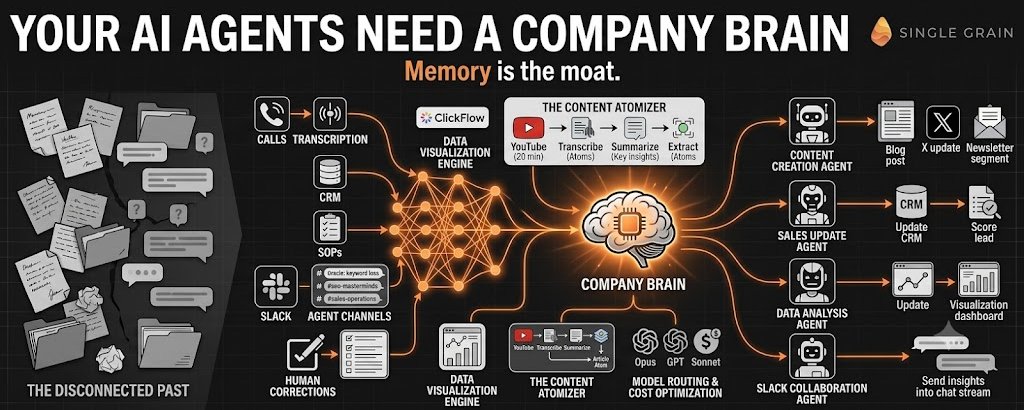
Eric Siu’s “Company Brain” architecture — the shared-memory layer (“memory is the moat”) that underpins these skills: scattered calls, CRM, SOPs, and Slack are atomized into one company brain that drives specialized output agents. Source: @ericosiu.
Key Takeaways
- 14 skill categories, each shipping a
SKILL.md+ Python scripts. Drop theSKILL.mdinto.claude/skills/and Claude Code can drive the underlying tools from a natural-language prompt. - Workflows, not prompts. Several categories run real statistics rather than vibes — Growth Engine uses bootstrap confidence intervals and Mann-Whitney U tests for A/B significance; Content Ops recursively scores against domain-expert personas until quality hits 90+.
- Coverage spans the full funnel: growth experiments, visitor→pipeline routing, content production, cold outbound, SEO, finance/CFO analysis, CRO, podcast repurposing, team performance audits, value-based sales pricing, slide-deck generation, YouTube competitive analysis, and X long-form writing.
- One category is Karpathy-inspired. Autoresearch runs optimization loops over conversion content — generate 50+ variants, score with an expert panel, evolve the winners — the same generate→score→evolve pattern as Thu Vu’s AutoResearch walkthrough.
- “Treat AI like an operating system, not a chat box” is the explicit framing — run the skill, review the output, improve the workflow, repeat — a concrete instance of the Claude-Code-as-AIOS pattern.
- MIT license (genuinely reusable/forkable), maintained (pushed 2026-05-31), backed by an operator with a real agency track record — clears the bar for a citeable community skill repo.
The 14 Categories
- Growth Engine — autonomous experiments that run, measure, and optimize themselves (Experiment Engine, Pacing Alerts, Weekly Scorecard). Bootstrap CIs + Mann-Whitney U for significance.
- Sales Pipeline — anonymous visitors → qualified pipeline (RB2B Router, Deal Resurrector, Trigger Prospector, ICP Learner). “Deal Resurrector” follows a departed champion to their new company; “ICP Learner” rewrites your ideal-customer profile from actual win/loss data.
- Content Ops — content that scores 90+ (Expert Panel, Quality Gate, Editorial Brain, Quote Miner). Ships 9 expert-panel definitions + 5 scoring rubrics.
- Outbound Engine — ICP definition → emails in inbox (Cold Outbound Optimizer, Lead Pipeline, Competitive Monitor).
- SEO Ops — keywords competitors missed (Content Attack Briefs, GSC Optimizer, Trend Scout).
- Finance Ops — “AI CFO that finds hidden costs in 30 minutes” (CFO Briefing, Cost Estimate, Scenario Modeler).
- Conversion Ops — score any landing page; survey data → lead magnets (CRO Audit, Survey-to-Lead-Magnet Engine).
- Podcast Ops — one episode → 20+ content pieces (Podcast-to-Everything Pipeline, Content Calendar).
- Team Ops — performance audits + meeting intelligence (Elon Algorithm, Meeting-to-Action Extractor).
- Sales Playbook — value-based pricing framework (Pre-Call Briefing, Tiered Packager, Call Analyzer, Pattern Library).
- Autoresearch — Karpathy-inspired conversion-content optimization (Variant Generator, Expert Panel Scorer, Evolution Engine).
- Deck Generator — slide decks with consistent visual styles (Image Generator, Google Slides Builder, Style Presets).
- YT Competitive Analysis — outlier videos + packaging patterns (Outlier Detector, Title Pattern Extractor, Channel Benchmarker).
- X Long-Form + Humanizer — human-sounding X articles with a 24-pattern AI-slop detector (Post Writer, Humanizer Checklist, ASCII Diagram Builder).
Implementation
- Repo:
github.com/ericosiu/ai-marketing-skills - Stars: 2,521 (2026-06-01) · Language: Python · License: MIT
- Setup: clone →
cd <category>→pip install -r requirements.txt→cp .env.example .env(add API keys) → run the category’s Python entrypoint. - Claude Code integration:
cp ai-marketing-skills/<category>/SKILL.md .claude/skills/<category>.md, then prompt naturally (e.g. “Run an experiment testing carousel vs. static posts on LinkedIn”) and the agent invokes the scripts. - Integration notes: each category is self-contained with its own README and
.env.example; per-skill API keys are the main external dependency. The maintainer’s “battle-tested / millions in revenue” framing is a vendor claim, not independently verified ^[ambiguous] — the code, license, and statistical methods are verifiable; the revenue outcomes are not.
Try It
- Steal one skill, not the whole repo. Clone it and copy a single high-leverage
SKILL.mdinto a WEO Marketly Claude Code project —content-ops(Expert Panel → 90+ quality gate) orseo-ops(Content Attack Briefs + GSC Optimizer) are the closest fit to existing dental-client content/SEO work. - Compare Autoresearch against the wiki’s own loop. Read
autoresearch/next to Thu Vu’s AutoResearch — both are generate→score→evolve; lift whichever variant/scoring structure is cleaner for ad-copy iteration. - Mine the X Long-Form Humanizer’s 24-pattern slop list. It’s a ready-made checklist for de-slopping agent-written copy — useful even if you never run the rest of the repo.
- Cross-check the statistics. Growth Engine’s bootstrap-CI / Mann-Whitney U approach is a model for doing A/B significance properly inside an agent workflow rather than eyeballing lifts.
Related
- Marketing Skills Bundle (Corey Haines)
- social-media-skills (Charlie Hills)
- email-campaigns-claude (Ira Bodnar)
- Six Best Claude Code Skills for Business
- Best Skill System Is the One You Build Yourself
- Claude Code as AI Operating System
- Thu Vu’s AutoResearch Walkthrough
- Career-Ops — Multi-Agent Job Search on Claude Code — productivity-domain sibling skill-collection repo (job search vs marketing/sales ops)